

To build or not to build a BA community? That is the question. During my presentation on the stage of the BA & Beyond conference in Copenhagen 2025, I explored this dilemma through a three-part drama inspired by my own experiences.
Act 1: Community
In our professional lives, we Business Analysts often exist as small islands. While developers usually work in teams where they can bounce ideas off one another, a BA is frequently the only one of their kind on a project, making us feel isolated. Like an island.
This is where a Community of Practice (CoP) can help. According to Etienne and Beverly Wenger-Trayner, a CoP is “A group of people who share a concern or passion for what they do and learn how to do it better through regular interaction”.
A community of practice brings five important benefits:
- Socializing: We interact with each other and understand that we are not, in fact alone, breaking the isolation of the “BA Island”.
- Learning: We can engage in study groups to grow together or learn from other members.
- Sharing: We can exchange knowledge and experiences.
- Solving Problems: We can consult with those who have faced similar project hurdles.
- Improving: We can build best practices and define the role of the BA in our context.
Act 2: Challenges
Although very useful, building and keeping a business analysis community engaged can be very challenging. To understand the challenges of building such a community, I want to share a personal experience.
The Evozon BA Community
At evozon, the BA community of roughly 30 members follows a structure I like to compare to coffee: from the concentrated “espresso” core to a diluted “latte” exterior (fig. 1 ).
- Core (3 people): These are the organizers. The people who set up the community’s meetings, find topics to discuss and often present and facilitate the meetings.
- Active (6 people): Regular participants who share information and ask questions.
- Occasional (15 people): Those who join when they can, who are there to learn and get information.
- Peripheral (10 people): People who have heard of us but don’t quite see the value yet, so they rarely participate.
- Outside (4 people): Management and HR who observe from afar.
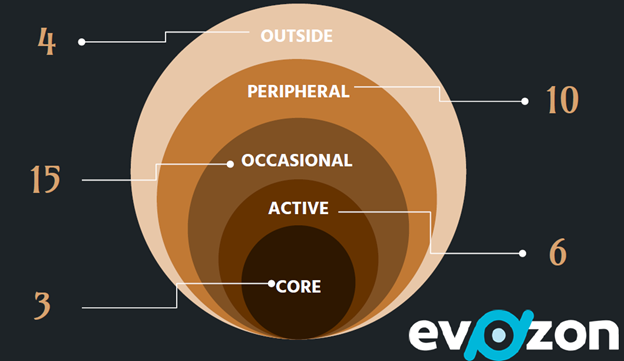
Fig. 1: BA Community “Coffee”
A Fateful Day in August
In August 2023, we organized a meeting called “Jokes and Coffee”, complete with free drinks and snacks. Out of 30 people, only 6 showed up (fig. 2). Once you accounted for the CEO, the department manager, and two aspiring BAs, there was only one practicing BA in the room besides me.
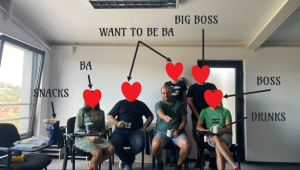
Fig. 2 “Jokes and Coffee” Meet
I found myself spiraling through the five stages of mourning.
I went from Denial (blaming summer vacations) to Anger (wondering why people didn’t want to evolve), to Bargaining (begging people to join), and Depression (wanting to drop the community entirely). Finally, I reached Acceptance, realizing that, like Elsa from Frozen, small groups never bothered me anyway.
Common Challenges
But still, I couldn’t help but wonder: Are we the only ones facing these issues? Are other communities doing better?
So, I asked for help from fellow speakers and BAs from other communities.
I soon discovered that our community was facing “villains” common to many communities:
- Absenteeism: Many people fail to show up. Because they are simply too busy or away, or they don’t see the benefit of the community.
- Passivity: When members do show up, they wait for knowledge to “fall from the heavens” without engaging.
- No Leadership: Everyone wants to meet, but no one takes the initiative to pick a date and a topic.
- Isolation: Remote work has broken social constructs, making people reluctant to join yet another (online) meeting.
- Inhibitions: The fear of being judged as unknowledgeable prevents people from asking questions.
Act 3: A Way Out
I also asked what other communities have done that made an impact. I took inspiration from those discussions and took a few measures that helped our community.
Get a Leader
A community doesn’t need a complex management structure, but it does need a facilitator to keep the momentum going. I stepped into this role to ensure we kept moving forward.
Meet More Often
Instead of meeting once a month, where a couple of missed sessions means a member is gone for a whole trimester, we started meeting more often at different times. We now rotate through:
- The first Friday of the month at 9:30 AM.
- The second Thursday of the month at 12:00 PM.
- A lunch outing on the third Tuesday of the month. (after pay day)
- The last Monday of the month at 5:00 PM.
This gives everyone, regardless of their client meeting schedules, a chance to participate.
Learn Together
We moved beyond just socializing to introducing a book club and a “Lean Cafe”. The Lean Cafe is very interesting because it need no formal preparation; we simply choose a subject and share what we know.
Open the Community
We opened our doors to the wider community for events like “In autumn we count our BAs” that reached its 3rd edition last November, or “Writing User Stories to Santa” where we enjoyed mulled wine.
On the 12th of February 2026 we’ll meet again with fellow BAs from Cluj for a “Love Letter to Business Analysis”.
What Can You Do?
You might think that this all seems too intimidating. But you don’t need to do big things to contribute to your community. There are three simple ways to get involved:
- Passion: Talk about a topic you love. Maybe it’s AI, data, or process modelling. Or stakeholder interaction, or a specific technique or approach. You can also share an article you enjoyed.
- Challenge or Achievement: Share a struggle you overcame or a mistake you learned from. Or that someone in your team, or your project went through. Alternatively, you can talk about what your team accomplished and, more importantly, how they did it. All the small victories count and can help motivate someone.
- Help out: At the very least help your colleagues.
When I prepared for my Copenhagen presentation, I asked my community for help. Instead of one person showing up, 15 people joined to support me and provide feedback on my presentation. It was a great feeling to see so many people willing to help.
John F. Kennedy once said: “Ask not what the country can do for you. Ask what you can do for your country”. And I think this can apply to your community of practice: “Ask not what your community can do for you, but what you can do for your community”.
A Personal Dilemma
I’d like to close out the article with a personal dilemma and confession. I did not write this article. I edited this article.
- I used NoteGPT to extract the transcript from my personal recording of the presentation I gave at the BA & Beyond conference.
- I asked Chat GPT to remove the filler words
- In Notebook LM I uploaded:
- The updated presentation transcript
- A link to all my articles on the evozon blog.
- The PowerPoint I used as support for the presentation
- I asked Notebook LM to create an article in the style of my articles posted to the blog that respects the structure of my PowerPoint based on the transcript.
- I then edited the text, formatted the text and added a few pictures.
I know I’ve done all this work. I haven’t “borrowed” materials from others. But is it me?
I can’t help but feel a bit dirty.
What do you think?