
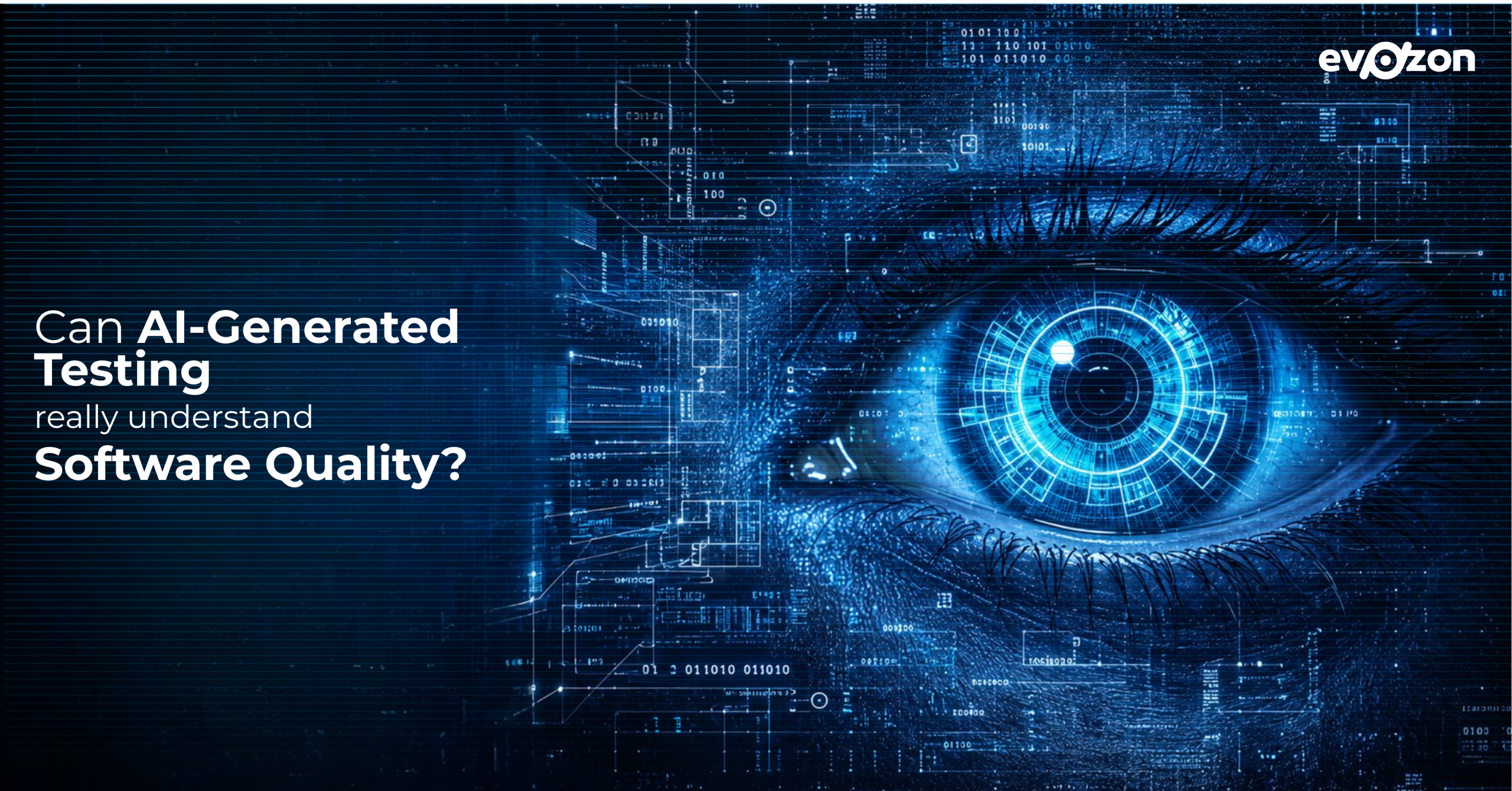
Artificial intelligence is rapidly transforming software testing. What began as an experimental capability has evolved into a practical component of modern quality assurance strategies, with AI-powered tools capable of generating automated test cases, analyzing logs, and identifying application changes with minimal human intervention.
As organizations continue to accelerate software delivery through Agile and DevOps practices, AI-generated testing is helping teams improve efficiency, reduce maintenance effort, and scale automation across increasingly complex systems. At the same time, it is raising critical questions: can artificial intelligence truly understand software quality, especially in systems shaped by business rules, user expectations, and contextual behavior, or is it simply becoming better at generating tests?
Industry analysts and QA teams report that while AI significantly improves efficiency, human judgment remains essential in evaluating risk, interpreting behavior, and identifying what should actually be tested.
Can Artificial Intelligence understand software quality?
AI-assisted testing tools are increasingly used to generate automated test flows based on application structure, user interactions, and historical execution data. In many development environments, these systems reduce the time required to create and maintain automated tests.
Modern AI testing platforms are increasingly capable of:
| Automatically generating test cases from application workflows | Identifying changes in user interfaces and updating test scripts |
| Prioritizing high-risk tests before deployment | Detecting unstable or flaky test scenarios |
| Analyzing historical execution data to improve coverage | Accelerating validation within CI/CD pipelines |
This allows teams to scale testing activities more efficiently within CI/CD pipelines. As release cycles become shorter, organizations rely more heavily on AI-assisted automation to maintain delivery speed without increasing manual effort.
Does high test coverage guarantee software quality?
The expansion of AI-generated testing introduces a growing distinction between executing checks and understanding quality. While AI tools can create large numbers of automated tests, coverage alone does not guarantee that critical risks are being validated.
AI systems can generate hundreds or even thousands of test cases in a relatively short period. However, many of these tests focus primarily on validating technical functionality rather than assessing whether an application delivers meaningful value to users or aligns with business objectives.
A system may achieve impressive coverage metrics while still failing to detect: critical business logic defects, poor user experiences, workflow inefficiencies, security vulnerabilities, edge-case scenarios, and operational risks.
As a result, QA professionals increasingly warn against equating automated activity with effective validation, particularly in complex enterprise systems.
Why AI still struggles to understand business context
Business context remains one of the greatest challenges for AI-powered QA systems. Software quality is rarely defined only by technical correctness, but is often shaped by contextual factors that are difficult to infer automatically. Business priorities, workflow dependencies, usability expectations, and customer behavior influence whether a feature is considered reliable or problematic.
AI-generated tests can validate predefined flows, but they may struggle to identify scenarios that emerge from ambiguous requirements, changing priorities, or real-world usage patterns.
This limitation is particularly visible in applications where user behavior is unpredictable or where business decisions influence functionality in ways that are not explicitly documented.
What are the risks of relying too heavily on AI-Generated tests?
As organizations adopt AI-generated testing at scale, some QA teams report increasing concern about false confidence created by large automated test suites.
When hundreds or thousands of tests execute successfully, teams may assume that systems are adequately validated even when important risks have not been explored. This becomes especially problematic when generated tests focus on expected paths while overlooking unusual user behavior or edge-case interactions.
The issue is not necessarily that AI-generated tests are incorrect, but that they can create an illusion of completeness that masks critical quality issues, if human review and risk analysis are reduced.
Can AI replace exploratory testing?
Despite significant advances in automation, exploratory testing remains one of the areas least affected by AI automation. Human testers continue to identify unexpected behaviors, inconsistencies, and usability concerns through observation and adaptive thinking.
Unlike predefined automated scenarios, exploratory sessions evolve dynamically based on system behavior and tester intuition. This makes them particularly effective in early-stage features, unstable environments, and systems with rapidly changing requirements.
Human testers frequently identify: usability concerns, inconsistent user experiences, ambiguous requirements, unexpected workflows, hidden edge cases, and risks emerging from changing business priorities.
While AI tools may support exploratory workflows through suggestions and analysis, they do not independently replicate human reasoning, skepticism, or curiosity.
How is AI changing the role of QA engineers?
The increasing adoption of AI-assisted testing is changing the responsibilities of QA professionals. In many teams, the role is shifting away from repetitive execution and toward evaluating outputs, interpreting quality signals, and identifying areas of elevated risk.
QA engineers are increasingly expected to understand business context, assess testing relevance, and validate whether automation aligns with real user expectations.
This transition reflects a broader movement toward quality engineering practices where analysis and decision-making become more valuable than manual execution volume.
How organizations are integrating AI testing into CI/CD Pipelines
AI-generated testing is becoming a central component of modern CI/CD environments.
Organizations continue to expand AI-generated testing within CI/CD workflows to improve speed and scalability. At the same time, engineering leaders increasingly emphasize the importance of governance, validation standards, and human oversight in AI-assisted QA processes.
Many organizations are implementing governance frameworks that emphasize: human review of AI-generated outputs, risk-based validation practices, testing explainability, automation accountability, and continuous monitoring of AI recommendations.
Several testing platforms have introduced features focused on explainability, risk prioritization, and human review to address concerns related to over-automation and reliability.
Conclusion
AI-generated testing is rapidly becoming a cornerstone of modern software quality assurance. It enables organizations to create automated tests faster, reduce maintenance overhead, improve test coverage, and accelerate software delivery.
However, generating tests is not the same as understanding software quality.
Software quality is ultimately defined by business context, customer expectations, risk management, usability, and real-world behavior. While artificial intelligence can support these objectives, it cannot fully replace the human judgment required to evaluate them.
As AI-powered testing continues to evolve throughout 2026 and beyond, the most effective quality strategies will combine intelligent automation with human expertise. Organizations that strike this balance will be better positioned to deliver software that is not only functional, but genuinely valuable, reliable, and aligned with user needs.
FAQ’s
1. What is AI-generated testing in software QA?
AI-generated testing uses artificial intelligence to create, maintain, and optimize automated test cases based on application behavior and historical data.
2. Does AI-generated testing replace human testers?
No. AI can automate repetitive testing activities, but human testers remain essential for exploratory testing, risk analysis, and contextual quality evaluation.
3. Why is false confidence a risk in AI-assisted testing?
Large automated test suites may create the impression that software is fully validated even when important edge cases or business risks are not covered.
4. What types of testing still require human judgment?
Exploratory testing, usability validation, risk-based analysis, and evaluation of ambiguous scenarios continue to depend heavily on human reasoning.